Quendro Pest Control GroupQuendro Pest Control Group

Rodent Exclusion and Abatement

Older Marion County properties—such as the historic brick residences in Irvington, Victorian builds in Woodruff Place, and craftsman homes in Broad Ripple—frequently present aging foundation mortar, unsealed crawlspace…
Call (463) 271-7277 →(463) 271-7277
Rodent Exclusion and Abatement in Indianapolis, IN
Quick answer
  • What is included: Full structural perimeter inspection, mechanical entry-point sealing using chew-proof materials, targeted interior trapping, and sanitation recommendations.
  • Response timeline: On-site assessments and active trap deployments are typically scheduled within 24 to 48 hours across Marion County.
  • Standard pricing: Service starts at a baseline minimum of $250 for localized entry-point sealing, with comprehensive whole-home exclusion ranging higher based on structural complexity.
  • Targeted pests: House mice, Norway rats, and roof rats infesting crawlspaces, basements, attics, soffits, and wall voids.
  • Booking process: Call (463) 271-7277 to arrange a detailed structural evaluation and receive an exact written quote finalized on-site.

Older Marion County properties—such as the historic brick residences in Irvington, Victorian builds in Woodruff Place, and craftsman homes in Broad Ripple—frequently present aging foundation mortar, unsealed crawlspace vents, and settled sill plates. As seasonal temperatures drop near corridors like the White River and Eagle Creek Park, rodents seek thermal shelter through openings as narrow as one-quarter of an inch. Implementing physical exclusion eliminates these entry pathways directly, protecting electrical wiring from gnawing hazards, preserving attic insulation, and keeping living spaces sanitary.

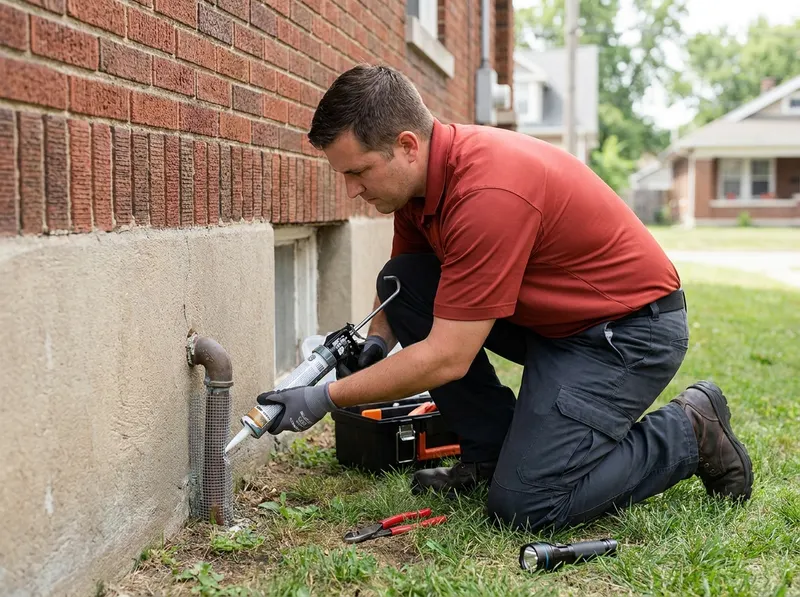
Traditional chemical baiting alone leaves exterior access routes completely unaddressed, resulting in continuous cycles of re-infestation and recurring service costs. Structural abatement focuses on biological defense: sealing utility penetrations, foundation weep holes, and garage door thresholds with heavy-gauge galvanized hardware cloth, elastomeric sealants, and metal flashing. This mechanical defense ensures indoor pets and children remain protected from broadcast rodenticides while preventing pests from expiring inside inaccessible interior wall cavities.

From wooded lots in Traders Point to dense residential parcels in Fountain Square and Garfield Park, every structure requires systematic identification of rub marks, gnaw patterns, and active runways. Technicians inspect rooflines, chimney flashing, and perimeter masonry to isolate primary travel routes. Every remediation plan is calculated to the specific footprint of the building, with all work scopes and exact investments confirmed on-site before sealing begins.

What it costs

Targeted Entry-Point Exclusion (Localized Foundation / Vent Seal)$250 – $450
Standard Residential Exclusion & Interior Trapping Program$550 – $1,250
Comprehensive Whole-Structure Exclusion (Multi-Story / Complex Rooflines)$1,250 – $2,400
Commercial Property Perimeter Exclusion & AbatementStarting at $650 (exact quote on-site)

Every job gets a firm, written price after a free on-site visit.

Common questions

How do I know if my Indianapolis home needs structural exclusion rather than simple trapping?
Exclusion is required when rodents consistently return each season or gain entry through foundation cracks, roof transitions, or utility penetrations. While trapping addresses the animals currently indoors, physical exclusion seals the envelope of your Indianapolis property to stop future migrations permanently.
Are rodent abatement protocols safe for pets and children in Indianapolis residences?
Yes, targeted exclusion relies primarily on non-toxic physical barriers such as steel mesh and industrial sealants. When interior population abatement is required, tamper-resistant trapping devices are deployed exclusively in secured, out-of-reach locations like locked crawlspaces and attics.
How long does a complete rodent exclusion service take on an Indianapolis property?
Most residential exclusion installations in Indianapolis take between four and eight hours of physical sealing labor. Follow-up monitoring and trap checks occur over a subsequent 7-to-14-day window to ensure all internal activity has ceased entirely.
Which areas of historic Indianapolis homes are most vulnerable to rodent entry?
Basement window frames, stone foundation seams, roof soffits, and crawlspace hatch covers are the most vulnerable zones in neighborhoods like Meridian-Kessler and Fletcher Place. Settled framing creates minor voids that rodents readily widen to access conditioned interior rooms.
Does rodent exclusion in Indianapolis require a long-term subscription contract?
No, mechanical rodent exclusion is designed as a standalone structural solution rather than an open-ended subscription. Once physical entryways are sealed and nesting rodents are captured, the home remains protected by the durable exterior barriers.

Ready to get started?

Tell us about your rodent exclusion and abatement job in Indianapolis and we'll send a clear, written quote — usually the same day.